Updating RabbitMQ with RabbitMQ Helper
You can choose from the following options for updating Erlang and RabbitMQ with RabbitMQ Helper:
-
Update Erlang: Update only Erlang to the latest version.
-
Update RabbitMQ: Update only RabbitMQ to the latest version.
-
Update Erlang and RabbitMQ at the same time: Update both Erlang and RabbitMQ to the latest versions.
If you use RabbitMQ Helper 11.x or earlier, we recommend that you perform a clean installation using Quorum Queues instead of trying to update your version.
From RabbitMQ v4.2, Khepri will be officially used as the default metadata store. For Khepri-related questions, see Khepri FAQ in the RabbitMQ documentation. To enable Khepri in RabbitMQ, use one of the following two options:
-
Enable Khepri by using the RabbitMQ Management UI. For more information about enabling Khepri using the RabbitMQ Management UI, see Using the Management UI in the RabbitMQ documentation.
-
Enable Khepri by using the CLI. For more information about enabling Khepri using the CLI, see Using the CLI in the RabbitMQ documentation.
If using RabbitMQ Helper v12.4.x, you will be prompted to enable Khepri before updating RabbitMQ via the RabbitMQ Helper UI.
You can update RabbitMQ and Erlang via the RabbitMQ Helper UI or by running appropriate PowerShell cmdlets in RabbitMQ Helper.
When updating RabbitMQ to a new version, RabbitMQ Helper takes care of enabling all required feature flags in RabbitMQ. If the new version introduces new feature flags, after the update is completed, the RabbitMQ management UI displays an "All stable feature flags must be enabled after completing an upgrade" banner. You will need to enable the required feature flags. For detailed information about how to enable the feature flags in RabbitMQ, see Troubleshooting.
Updating RabbitMQ via User Interface
Once you run RabbitMQ Helper, a welcome window with the documentation hyperlink appears. Select Next to see all the options available in RabbitMQ Helper.
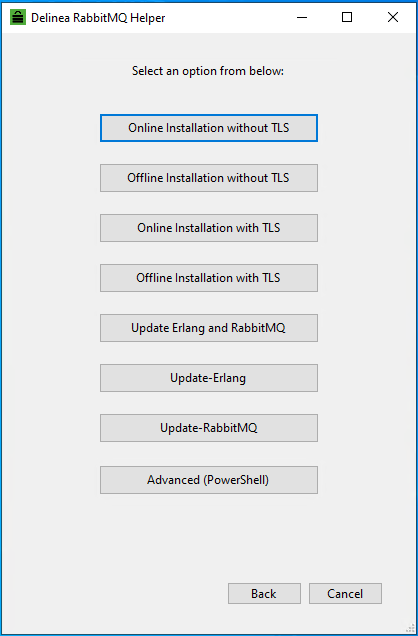
Select Update to see all the available update options.
The following table describes the options in the RabbitMQ Helper window and provides a link to more information about each option in this documentation.
| Option | Description |
|---|---|
| Update Erlang and RabbitMQ | Updates Erlang and RabbitMQ at the same time. |
| Update-Erlang | Manually updates Erlang by using the Erlang installer. |
| Update-RabbitMQ | Manually updates RabbitMQ by using the RabbitMQ installer. |
| Enable KhepriDB | Enables the migration from the Mnesia metadata store to Khepri in RabbitMQ. |
Updating Erlang and RabbitMQ via User Interface
Updating Erlang and RabbitMQ requires that you enable the khepri_db feature flag in RabbitMQ. From RabbitMQ v4.2.0, Khepri is the default metadata store backend for all new deployments. For more information about enabling Khepri, see the RabbitMQ documentation.
Perform the following steps to update Erlang and RabbitMQ to the latest available versions via the RabbitMQ Helper UI:
-
In the RabbitMQ Helper window, select Update.
-
Select Update Erlang and RabbitMQ from the update options.
When you select the Update Erlang and RabbitMQ option, you are asked to enable Khepri before the upgrade. You can enable Khepri in two ways:
-
Use the Enable Khepri DB update option in the RabbitMQ Helper window. For more information about using this option to enable Khepri, see Enabling Khepri.
-
Run the
Enable-KhepriDbPowerShell cmdlet.
After Khepri is enabled, you can proceed with updating Erlang and RabbitMQ.
Updating Erlang via User Interface
Perform the following steps to update Erlang to the latest available version via the RabbitMQ Helper UI.
-
In the RabbitMQ Helper window, select Update.
-
Select Update-Erlang from the update options.
-
Specify the path of the directory where Erlang is installed.
-
Provide the link or full directory path of the Erlang installer and select Next.
The updating of Erlang begins. A confirmation appears in the Command Run Output window when the update is complete.
Updating RabbitMQ via User Interface
Perform the following steps to update RabbitMQ to the latest available version via the RabbitMQ Helper UI.
-
In the RabbitMQ Helper window, select Update.
-
Select Update-RabbitMQ from the update options.
-
Specify the path of the directory where RabbitMQ is installed.
-
Provide the link or full directory path of the RabbitMQ installer and select Next.
The updating of RabbitMQ begins. A confirmation appears in the Command Run Output window when the update is complete.
Enabling Khepri
You can use the Enable KhepriDB update option to migrate from Mnesia to the Khepri metadata store in RabbitMQ and enable Khepri.
Perform the following steps to enable Khepri via the RabbitMQ Helper UI.
-
In the RabbitMQ Helper window, select Update.
-
Select Enable KhepriDB from the update options.
-
Consider the migration prerequisites and important notes in the Enable Khepri Metadata Store dialog.
-
Select Yes to begin the migration.
A confirmation appears when the migration is complete.
Updating RabbitMQ via PowerShell
You can update Erlang, RabbitMQ, or both Erlang and RabbitMQ at the same time by using appropriate PowerShell commands.
Updating Erlang via PowerShell
You can update Erlang to the latest available version by using a PowerShell command or from the RabbitMQ Helper UI. Before you begin installing the update, download the latest Erlang / OTP version installer from the Delinea Marketplace.
To update Erlang using a PowerShell command:
-
Run the following command in the Helper’s PowerShell window:
CopyUpdate-Erlang –UrlOrFilePath "<url-or-filePath>" -InstallPath "<Erlang-Directory>" -Verbose
-InstallPath is an optional parameter that specifies the installation directory. Include -InstallPath only if you want to install Erlang in a directory other than the default installation directory (C:\Program Files).
Updating RabbitMQ via PowerShell
You can update RabbitMQ to the latest available version by using a PowerShell command or from the RabbitMQ Helper UI. Before you begin installing the update, download the latest RabbitMQ version installer from the Delinea Marketplace.
To update RabbitMQ using a PowerShell command:
-
Run the following command in the RabbitMQ Helper PowerShell window:
CopyUpdate-RabbitMq –UrlOrFilePath "<url-or-filePath>" -InstallPath "<RabbitMQ-Directory>" -Verbose
-InstallPath is an optional parameter that specifies the installation directory. Include -InstallPath only if you want to install RabbitMQ in a directory other than the default installation directory (C:\Program Files).
Updating Erlang and RabbitMQ via PowerShell
You have an Update Erlang and RabbitMQ option in the RabbitMQ Helper UI to update Erlang and RabbitMQ at the same time. When you select this option, RabbitMQ Helper automatically downloads the latest Erlang and RabbitMQ version installers from the Delinea Marketplace and automatically installs the Erlang and RabbitMQ versions.
The Update Erlang and RabbitMQ option does not take a URL or a file path as user input, but it requires an internet connection.
You can update RabbitMQ and Erlang by using a PowerShell command or from the RabbitMQ Helper UI.
To update RabbitMQ and Erlang using a PowerShell command:
-
Run the following command in the RabbitMQ Helper PowerShell window:
CopyUpdate-Connector -InstallPath “<Erlang-RabbitMQ-Directory>” -Verbose
-InstallPath is an optional parameter that specifies the installation directory. Include -InstallPath only if you want to install Erlang and RabbitMQ in a directory other than the default installation directory (C:\Program Files).
RabbitMQ Helper automatically installs the versions of Erlang and RabbitMQ by using the downloaded installers.


