Mapping an SSH Key or Private Key Passphrase for Authentication
Some password changers may be customized to use SSH key authentication. Secret Server needs to know which text-entry fields contain the key and the passphrase. These text-entry fields can be specified after clicking Edit from the password changer page.
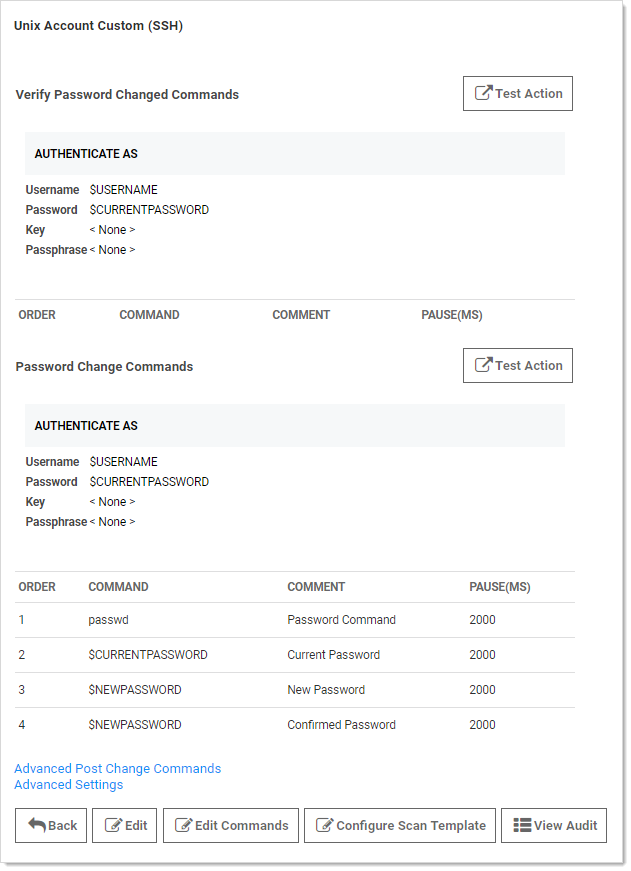
The key and passphrase must be identified by a $ sign and the secret text-entry field name, which can be obtained from the secret template.
Configuring Extended Mappings on the Secret Template
To tell Secret Server which text-entry fields hold the SSH private key and passphrase, configure the extended mappings on the secret template:
-
Search for Secret Templates. The Secrets Administration page is displayed.
-
In the Core Actions section, click Secret Templates. The list of available templates is displayed.
-
Select the template you want to configure, for example Unix Account (SSH Key Rotation), then click the Mapping tab.
-
If no SSH Private Key mapping exists, click Add Mapping to create one.
Selecting the Mapping Type
When adding a new extended mapping, the Mapping Type dropdown offers several options. For SSH key rotation, select SSH Private Key. This mapping type exposes three extended fields that must be mapped to the corresponding secret template fields. For more on the other available mapping types, see Creating or Editing Secret Templates.
Table: SSH Private Key Extended Fields
| Extended Field | Maps to Secret Field | Purpose |
|---|---|---|
| PRIVATEKEY | Private Key | Identifies the field that stores the SSH private key. |
| PASSPHRASE | Private Key Passphrase | Identifies the field that stores the passphrase protecting the private key. |
| PUBLICKEY | Public Key | Identifies the field that stores the SSH public key. |
Passphrase Behavior During Key Rotation
If your security policy requires passphrase-protected keys, ensure the PASSPHRASE field is mapped to the template field that holds the passphrase value. When the mapping is present, Secret Server generates a passphrase and uses it to encrypt the new private key each time the key is rotated.
When Mappings Are Needed
The built-in SSH Key templates ship with these extended mappings pre-configured. You typically only need to add or verify mappings in the following scenarios:
-
You created a custom template for Unix or Linux secrets and want to enable SSH key rotation on it.
-
You duplicated an existing template and the extended mappings were not carried over.
-
You renamed the key-related fields on a template and need to re-map them.
Extended Mappings and Launchers
Once Secret Server knows which text-entry fields contain the private key and private key passphrase, it can automatically use them as part of launchers, in addition to using them for key rotation.


