RDP Proxy
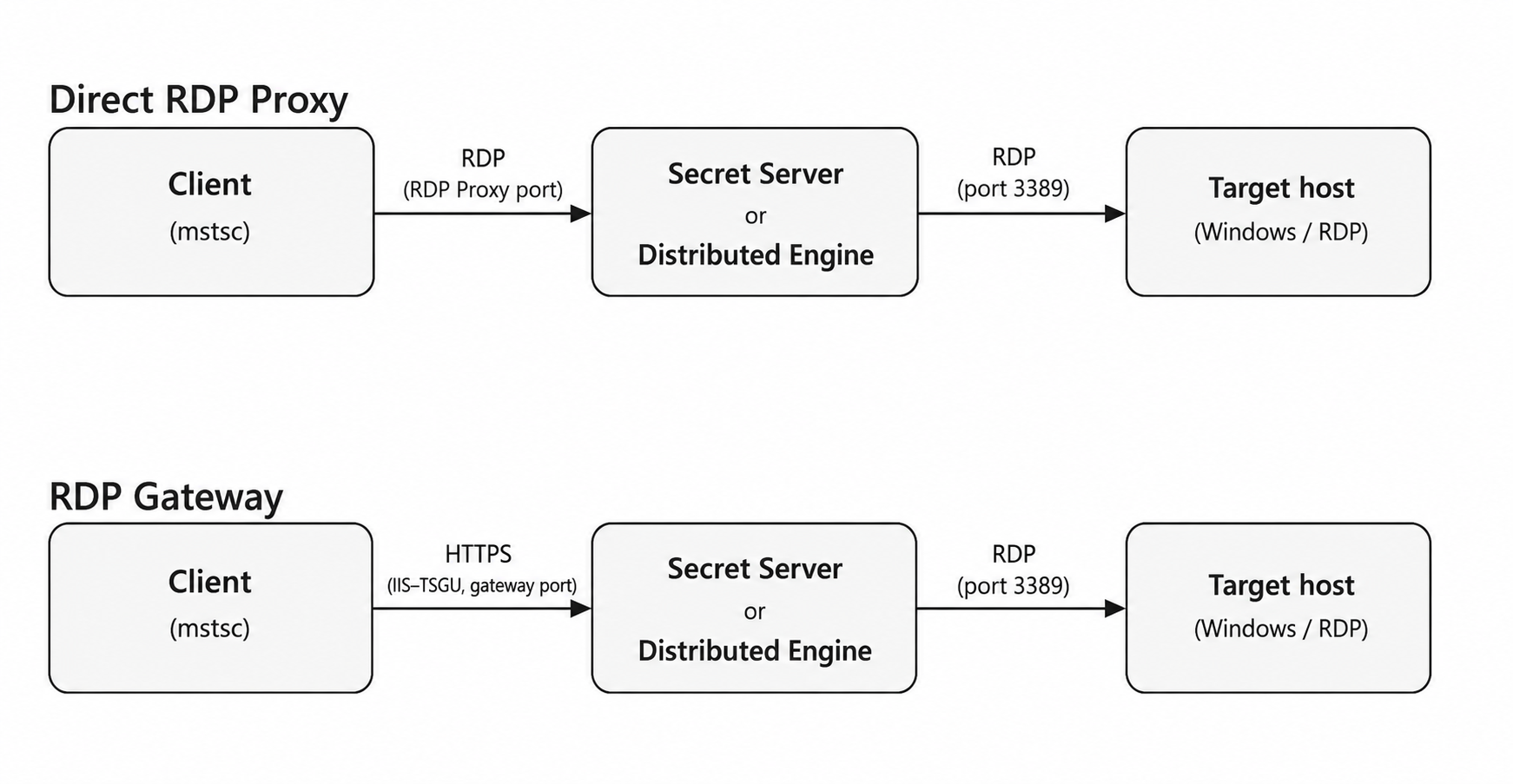
The RDP proxy feature in Secret Server enhances security by routing Remote Desktop Protocol (RDP) connections through Secret Server, ensuring that secret credentials are protected during remote access sessions. The RDP Proxy supports two operating modes for customer clients: a direct connection to the RDP Proxy port and a gateway mode that tunnels RDP over HTTPS using the Microsoft Terminal Services Gateway (MS-TSGU) protocol. Gateway mode removes NTLM (NT LAN Manager) from the client-to-proxy network leg, helping satisfy compliance requirements that restrict NTLM use.
Operating Modes
- Direct RDP Proxy. Clients connect to Secret Server or a distributed engine on the RDP proxy port. The proxy simulates an RDP handshake, retrieves temporary credentials, and forwards the session to the target.
- RDP Gateway. Clients tunnel RDP over HTTPS to the gateway listener and authenticate to Secret Server. Secret Server then forwards the inner RDP stream to the target.
- SSH tunneling. RDP tunneled inside an SSH proxy connection. This is retained for compatibility and is not recommended for new deployments.
Delinea recommends gateway mode for new deployments, because it consolidates inbound ports to standard HTTPS and removes NTLM from the client-to-proxy hop.
Availability
- On-premises: RDP Gateway mode is available in Secret Server 12.2.000007 and later, which bundles Distributed Engine 8.5.1.0 and Protocol Handler 6.0.3.56.
- Secret Server Cloud: The Enable RDP Gateway setting is available on Admin > Proxying > RDP Proxy. Gateway sessions additionally require Protocol Handler 6.0.3.51 or later on client machines and a Distributed Engine newer than 8.4.97.0 on every engine that serves gateway sessions.
Configuration Scope
Gateway activation, listener ports, and the certificate can be configured globally or overridden per-site and per-engine. Per-site and per-engine overrides take precedence over the global value. See RDP Proxy Configuration for the full overrides model.
Requirements
RDP proxy requirements:
- Client machines must use an RDP client that implements the remote desktop gateway protocol. The Microsoft Remote Desktop Connection client on a currently supported Windows release is the configuration validated by Delinea.
- Each distributed engine that serves gateway sessions must advertise the RD Gateway capability, which requires a Distributed Engine newer than 8.4.97.0. Older engines continue to serve direct RDP proxy sessions but cannot accept gateway connections.
- Client machines must run Protocol Handler 6.0.3.51 or later. Sessions launched with the Secret Server RDP Client do not use the gateway and connect to the direct RDP proxy port instead.
- A certificate that uses an RSA key pair, whose subject alternative name matches the hostname client's name is used to reach the gateway. That includes Server Authentication (OID 1.3.6.1.5.5.7.3.1) Enhanced Key Usage that is trusted by the client machine's certificate stores. See RDP Proxy Certificate Options.
-
The gateway listens on its own port (8443 by default), which must be reachable by client machines and must differ from the RDP proxy port (3390 by default). The default is deliberately not 443, so the gateway does not collide with the HTTPS port that IIS already uses on a Secret Server web node. The global port can be overridden per site and per engine.
Related Topics
See the following for more information


